Assisted Living vs Nursing Home Care in Cleveland: Costs and Differences
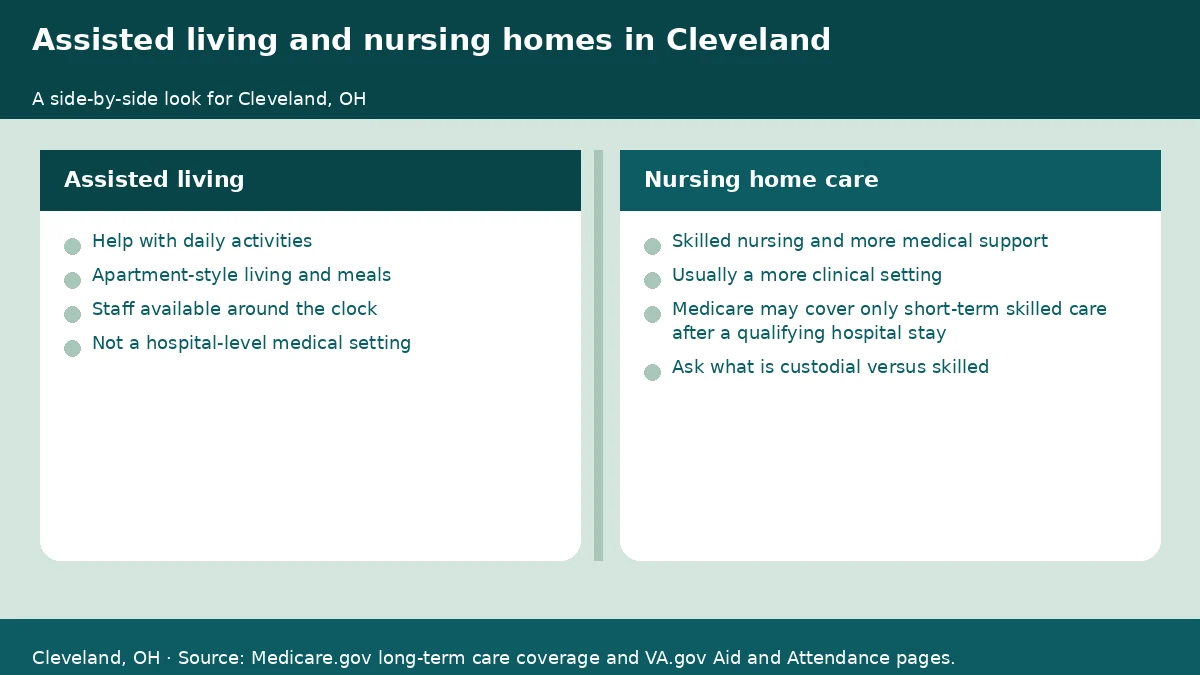
Assisted living and nursing home care are not interchangeable. Nursing homes provide round-the-clock skilled nursing; assisted living is meant for people who need help with daily activities rather than ongoing medical care. Ask each Cleveland provider for a written comparison that lists what is included.
Medicare does not pay for room, board, or ongoing custodial care in assisted living if that is the only care someone needs (Medicare.gov: long-term care coverage).
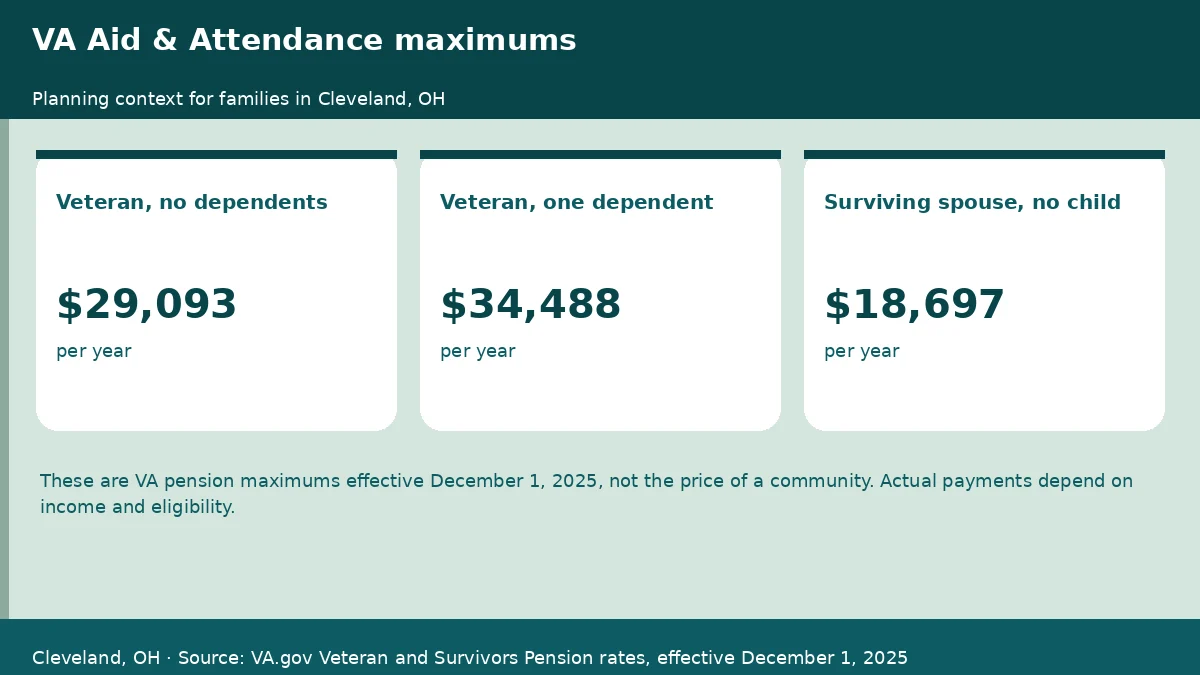
Eligible wartime Veterans and surviving spouses can review VA pension with Aid and Attendance. As of December 1, 2025, the maximum annual pension rate with Aid and Attendance is $29,093 for a Veteran with no dependents and $34,488 for a Veteran with one dependent (current VA pension rates). A surviving spouse’s Aid and Attendance maximum is $18,697 a year with no dependent children (VA Survivors Pension rates). These are benefit limits, not the price of a Cleveland community. The net worth limit for these pensions is $163,699 from December 1, 2025, through November 30, 2026.
For local public-benefit counseling, start with the federal Eldercare Locator at 1-800-677-1116, which connects families to the Area Agency on Aging that serves Cleveland, Ohio.
When an older parent in Cleveland needs more help, families often hear two terms used almost interchangeably: assisted living and nursing home. They are not the same. They provide different kinds of care, are regulated differently, are paid for differently, and cost very different amounts. Choosing the right one depends less on the price than on what your parent actually needs. This guide explains the differences, with 2025 cost data for the Cleveland area.
The 2025 costs in Greater Cleveland
On these figures, a semi-private nursing home room in the Cleveland area costs roughly 57 percent more than a median assisted living apartment, and a private nursing home room more than 80 percent more.
What assisted living provides
In Ohio, assisted living facilities are licensed as residential care facilities by the Ohio Department of Health. ODH describes them as providing accommodation and personal care services primarily to older adults (Ohio Department of Health, residential care facilities). In practice, assisted living typically offers:
- A private or shared apartment
- Meals, housekeeping, and activities
- Help with bathing, dressing, grooming, and other daily tasks
- Medication help
- Staff available around the clock
ODH notes that a residential care facility may choose to provide limited skilled nursing care, such as supervising special diets, applying dressings, and routine skilled nursing as determined by the resident's physician, and may provide other skilled nursing on a part-time, intermittent basis for no more than 120 days in a twelve-month period. Assisted living is built around a residential, social way of life, with care added as needed.
What a nursing home provides
A nursing home, also called a skilled nursing facility, provides 24-hour nursing care supervised by licensed nurses. It serves people who need ongoing medical care or a high level of physical help, such as:
- Complex medication regimens or injections
- Wound care or other daily skilled treatments
- Help with nearly all daily activities, including two-person transfers
- Recovery and rehabilitation after a hospital stay
- Significant medical instability
Nursing homes are more clinical by design. Many also provide short-term rehabilitation, which is a separate use from long-term care.
How payment differs
Medicare
Medicare does not pay for assisted living. It may cover a limited period of skilled nursing facility care after a qualifying inpatient hospital stay, when a person needs daily skilled care, but it does not cover long-term custodial care in a nursing home (Medicare.gov, skilled nursing facility care).
Ohio Medicaid
Ohio Medicaid covers long-term nursing home care for people who qualify medically and financially. For assisted living, Ohio offers the Assisted Living Waiver, which can pay for care services in participating facilities while the resident pays a set amount for room and board (Ohio Department of Aging, assisted living). Not every assisted living community participates, so ask.
Private pay and other sources
Both settings are often paid privately, with help from long-term care insurance or VA benefits where available. Our guide to paying for assisted living in Ohio covers these options.
Which setting fits?
Assisted living often fits when your parent
- Needs help with some daily activities but not constant medical care
- Can participate in meals and activities, with support
- Would benefit from company and a predictable routine
- Needs medication help, reminders, and someone available at night
- Is medically stable
A nursing home may be needed when your parent
- Needs daily skilled nursing care
- Requires help with almost every daily activity, around the clock
- Has complex or unstable medical conditions
- Is recovering from a hospital stay and needs intensive rehabilitation
The best source of guidance is your parent's physician, together with an honest assessment from the community you are considering.
The middle ground
Many people move through these settings over time. A parent might go from a hospital to a short rehabilitation stay in a skilled nursing facility, and from there to assisted living rather than back home. Others live in assisted living for years before needs grow beyond what it can provide. Short respite stays can also bridge gaps after a hospital discharge; see our article on respite care in Cleveland.
Beyond cost: daily life
Price is important, but daily life matters too. Assisted living tends to feel more like home: residents furnish their own apartments, come and go to meals, and choose activities. Nursing homes, by necessity, are organized around medical care. For a parent who does not need that level of care, assisted living can offer more privacy, independence, and dignity at a lower cost.
Questions to ask both kinds of setting
- What care needs can you meet, and which can you not?
- How many staff are on duty during the day and overnight?
- Who administers medications?
- How do you handle falls and hospital transfers?
- What does the monthly rate include?
- Do you accept Ohio Medicaid or the Assisted Living Waiver?
- What happens if my parent's needs change?
Check quality
The Ohio Department of Aging's Long-Term Care Quality Navigator lets families search for nursing homes and assisted living facilities by city or ZIP code and see information drawn from several sources, including resident and family satisfaction surveys (Ohio's Long-Term Care Quality Navigator). It is a useful place to start comparing.
Talk with Lakeview
Lakeview Senior Living of Cleveland offers assisted living and respite care. We are glad to talk honestly about whether assisted living is the right fit for your parent. Request a tour to visit and ask questions.
Frequently asked questions
How much more does a nursing home cost than assisted living in Cleveland?
No. Medicare does not pay for room, board, or ongoing personal care in assisted living if that is the only care needed.
Does Medicare pay for a nursing home?
Medicare may cover a limited period of skilled nursing facility care after a qualifying hospital stay. It does not pay for long-term custodial care or for assisted living.
Can someone move from a nursing home to assisted living?
Yes. Ohio's Assisted Living Waiver even includes community transition funds for people moving from a nursing facility into assisted living.
Who licenses assisted living in Ohio?
The Ohio Department of Health licenses and inspects assisted living facilities as residential care facilities.